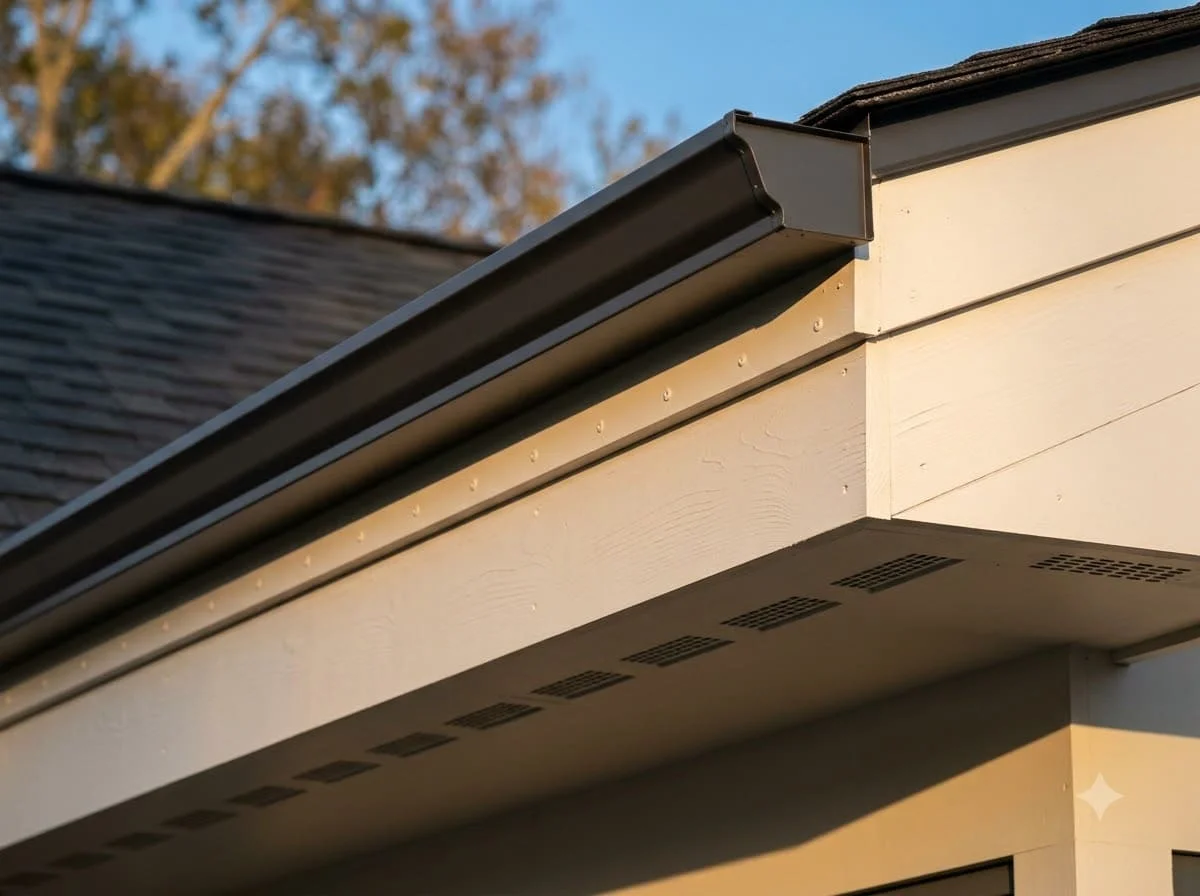
Fascia board materials fall into five practical options, ranging from $6 per linear foot for painted wood to $25 for fiber cement installed. The choice matters more than most homeowners expect, because fascia is the only exterior trim on a house that carries a real structural load — a 40-foot gutter run full of water weighs several hundred pounds, and every ounce of it hangs off the fascia.
That single requirement reshapes the whole comparison. A material can be perfectly rot-proof and still be a poor fascia board if it will not hold a fastener. Soffit Fascia Repair's contractors see homes every week where a premium board was installed correctly on its own terms and the gutters still pulled away, because nobody accounted for what was behind them. Below is how the five materials actually compare on the things that decide the outcome.
Fascia Board Materials at a Glance
Fascia board materials compare across four dimensions that matter in practice: installed cost, service life, whether the board can hold gutter fasteners on its own, and how much maintenance it demands.
| Material | Cost / LF | Life | Holds Gutters |
|---|---|---|---|
| Painted wood | $6–$12 | 10–25 yrs | Yes — best |
| Aluminum-wrapped wood | $9–$18 | 30–40 yrs | Yes — wood core |
| PVC / cellular | $12–$22 | 40–50 yrs | No — needs backing |
| Fiber cement | $14–$25 | 30–50 yrs | Partial — pre-drill |
| Composite / engineered | $10–$20 | 25–40 yrs | Yes — if kept dry |
Painted Wood — Cheapest to Buy, Most Expensive to Own
Painted wood fascia is the cheapest material to buy and the most expensive to own over any long horizon. Pine, spruce, and fir boards run $6 to $12 per linear foot installed and hold gutter fasteners better than anything else on the list, which is exactly why the building industry used them by default for a century.
The weakness is the same one that governs wood soffit: the paint film is the only thing standing between the board and decay. Fascia sits directly under the roof edge and behind the gutter, which is the wettest position on the entire exterior. When the paint cracks, water reaches end grain at the joints and rot follows quickly.
Cedar and redwood are the exceptions worth knowing about. Both carry natural decay resistance and can reach 25 years or more with proper finishing, at a material premium of roughly 50% to 100% over pine. On a historic or high-end home where a painted wood profile is architecturally correct, cedar fascia is a legitimate long-term choice rather than a compromise.
Aluminum-Wrapped Wood — The Practical Default
Aluminum-wrapped wood is the practical default for most American homes, and it is what the majority of replacement jobs use. A solid wood board is installed to carry the structural load, then aluminum trim coil is bent on site and capped over it to shield the wood from weather. The result costs $9 to $18 per linear foot and needs no painting for 30 to 40 years.
The reason it works is that it splits the job in two. Wood does what wood is good at — holding fasteners and carrying the gutter load. Aluminum does what aluminum is good at — shedding water and holding a factory finish without maintenance.
It also has a well-known failure mode, and it is worth understanding before you buy. If water gets behind the wrap, the wood rots invisibly while the aluminum face still looks flawless from the ground. The entry points are almost always the same three: an unsealed top edge where the drip edge should lap over the wrap, unsealed end seams at corners and joints, and holes punched through the wrap by gutter spikes. This is why fascia rot so often surprises homeowners with wrapped fascia — the concealment is the whole point of the system, and it conceals problems as well as wood.
PVC and Cellular Composite — The Rot-Proof Option
PVC fascia is genuinely rot-proof, which is what makes it the strongest performer in wet, humid, and coastal climates. Cellular PVC contains no organic material at all, so decay fungi and wood-boring insects have nothing to work with. It does not absorb water, does not swell, and holds paint well if you want a custom color rather than the factory white.
Its limitation is structural, and it is the reason PVC cannot simply be swapped in one-for-one. PVC has poor fastener retention compared to wood — a gutter hanger screwed into PVC alone will work loose under load. Correct installation anchors gutters through the PVC into solid sub-fascia or rafter tails behind it.
PVC also moves significantly with temperature, expanding and contracting far more than wood across a seasonal swing. Long runs need proper expansion gaps at joints, and installers who butt PVC tight in cool weather will see buckled seams by August. Cost runs $12 to $22 per linear foot installed.
Fiber Cement and Composite — The Specialist Choices
Fiber cement fascia suits two situations specifically: fire-prone regions and homes where matching existing fiber cement siding matters visually. The material is non-combustible, holds paint exceptionally well, and resists insects and rot. At $14 to $25 per linear foot installed it is the most expensive option here, largely because it is heavy and slow to work with.
Its weak point is the cut edge. Fiber cement is only water-resistant, not waterproof, and unsealed edges wick moisture and swell over time. Every cut end needs sealing, and fastener holes need pre-drilling to avoid cracking the board.
Engineered wood composites sit in between. They cost $10 to $20 per linear foot, hold fasteners nearly as well as solid wood, and resist rot better than untreated pine. They are a reasonable middle path in moderate climates, but they still contain wood fiber, so sustained saturation behind a failing gutter will eventually swell and delaminate them.
Choosing by Climate
Climate should drive the decision more than price does, because the dominant stressor in your region determines which failure mode you are actually buying protection against.
- Humid Southeast and Gulf Coast. Rot risk is the highest in the country and paint films fail fast. PVC or aluminum-wrapped wood. Bare painted wood is a short-term choice here.
- Coastal and salt air. PVC leads because salt does not touch it. Aluminum works well provided the finish stays unscratched and the fasteners are stainless.
- Northern freeze-thaw and snow country. Ice dams push water back over the roof edge and behind the fascia, so sealing at the top edge matters more than the material. Aluminum-wrapped wood with a properly lapped drip edge performs well. See ice dams and soffit damage.
- Hot and high-UV Southwest. Thermal movement dominates. Aluminum-wrapped wood or fiber cement, with attention to expansion gaps on any PVC.
- Wildfire-exposed areas. Fiber cement, for the non-combustible rating.
The Question That Matters More Than Material
The question that matters more than material is what your gutters are fastened to. Fascia fails at the fastener line far more often than it fails across the board face, because that is where the load concentrates and where water enters through the penetration.
Old gutter spikes are the classic culprit. A spike driven through fascia into a rafter tail works loose as the wood cycles wet and dry, then the gutter sags, then the sag holds standing water, and the extra weight opens the hole further. Hidden hangers that screw into solid backing distribute the load far better and are worth specifying on any gutter installation job.
This is also why fascia and gutter work belong together. Replacing fascia without rehanging the gutters correctly leaves the new board carrying the same concentrated loads through the same compromised points, and that relationship is covered in detail in why gutters cause fascia rot.
Not sure which material fits your house? Call Soffit Fascia Repair at (855) 606-2187 for a free inspection. A contractor will check what your fascia is made of now, probe for hidden damage behind any aluminum wrap, confirm what your gutters are anchored into, and quote the options that actually suit your climate. Current pricing is in our fascia replacement cost guide.
Frequently Asked Questions
What is the best material for fascia board?
For most homes, aluminum-wrapped wood offers the best value — a solid wood board carries the gutter load while aluminum trim coil keeps water off it, for roughly $9 to $18 per linear foot installed with no repainting for 30 to 40 years. PVC is the strongest choice in wet and coastal climates because it cannot rot, though it costs more and cannot hold gutter fasteners on its own. Fiber cement suits fire-prone regions. Bare painted wood is cheapest but returns to a repaint cycle every seven to ten years.
Is PVC fascia better than wood?
PVC beats wood on durability and loses on structure. It cannot rot, absorb water, or feed insects, making it excellent in humid, coastal, and heavy-rain climates where wood fails fastest. What it cannot do is hold a gutter by itself — PVC has poor fastener retention, so gutters must be anchored through it into solid backing behind. It also expands and contracts more than wood, so seams need proper gapping. On a home with sound sub-fascia to anchor into, PVC is the longer-lasting board.
How long does aluminum fascia last?
Aluminum fascia wrap lasts 30 to 40 years, but only if the wood underneath stays dry. Aluminum capping is trim coil, not a structural board — it is bent around a wood fascia to shield it. Where the wrap is sealed correctly at the top edge under the drip edge, the wood behind lasts decades. Where water gets behind it through an unsealed seam or a gutter spike hole, the wood rots invisibly while the aluminum still looks perfect. That is the most common hidden fascia problem we find.
What size are fascia boards?
Most residential fascia is a nominal 1x6 or 1x8 — 5.5 or 7.25 inches actual width — with 1x8 most common on homes built since the 1980s. Older homes and larger roofs sometimes use 1x10 or 1x12. Board width is set by rafter tail depth and roof pitch, so it is not a free choice; replacement fascia should match the existing depth or the drip edge and gutter alignment will be wrong. Thickness is typically a nominal one inch, dressing out to three-quarters.
Can you put new fascia over old fascia?
Aluminum trim coil is routinely wrapped over existing wood fascia, and that is standard practice when the wood underneath is sound and dry. It is not acceptable when the wood is already rotting — capping over decay seals moisture in, hides the damage, and leaves the gutter fastened into wood losing its grip. A correct job probes the existing board first, cuts out and replaces anything soft, and only then wraps. If a quote skips the probe, it is capping over a problem.