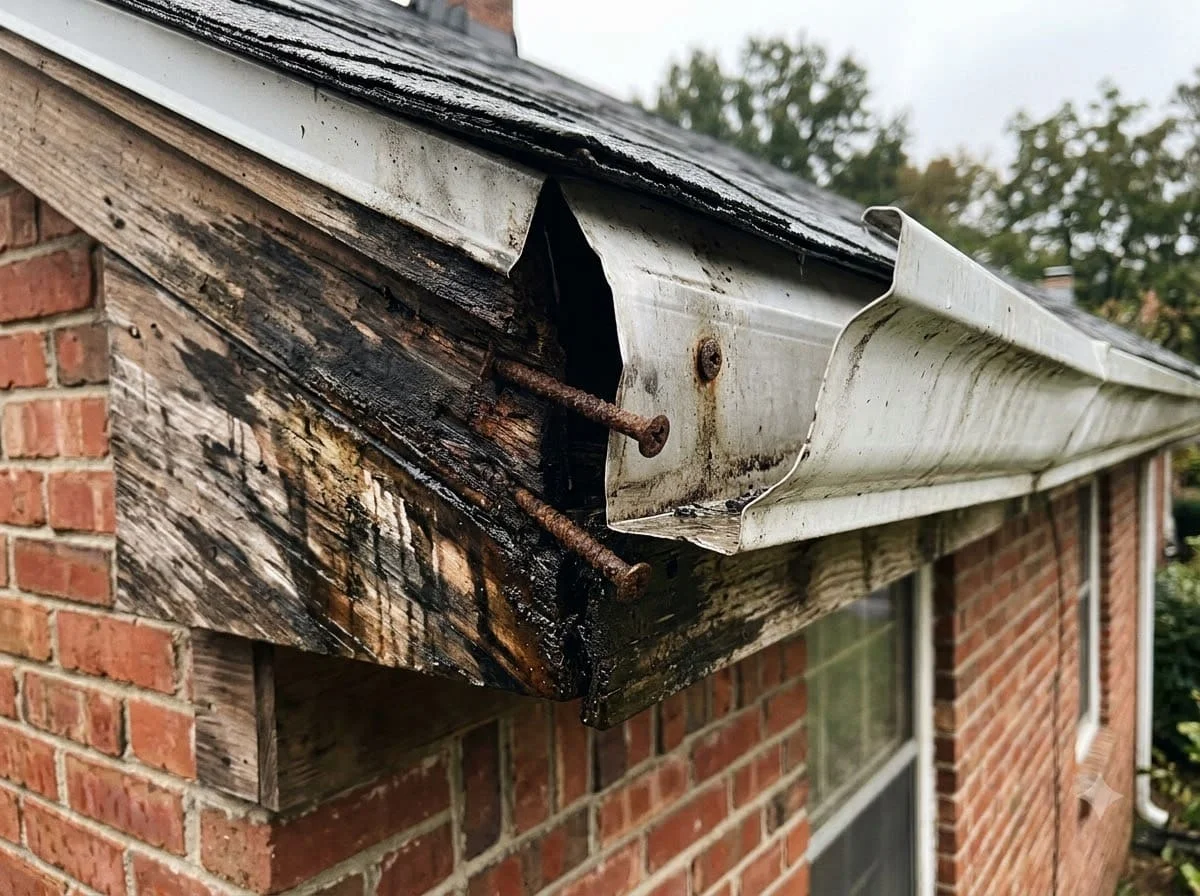
Gutters cause more fascia rot than any other single factor, and a 40-foot gutter run full of water weighing several hundred pounds is only part of the reason. The bigger problem is geometric: the gutter is fastened directly through the fascia board, sits tight against it for its entire length, and concentrates every gallon of roof runoff at exactly that joint.
Homeowners tend to think of gutters and fascia as separate items — one is drainage, one is trim. Structurally they are a single assembly, and they fail as one. Soffit Fascia Repair's contractors almost never find rotted fascia with healthy gutters above it. Understanding the four specific ways that connection goes wrong is what lets you fix the cause instead of replacing the board every decade.
How the Gutter and Fascia Actually Connect
The gutter and fascia connect through three components, and each one is a potential failure point.
The fascia board runs horizontally along the roof edge, closing off the ends of the rafter tails. It is structural — it carries the gutter's entire load.
The hangers or spikes pass through the back of the gutter and into the fascia, every 24 to 36 inches. Each one is a hole punched through whatever protective layer the fascia has, whether that is paint or aluminum wrap.
The drip edge is bent flashing at the roof edge that should extend past the fascia and deliver runoff into the gutter. It is the only component whose job is specifically to keep water off the fascia's top edge, and it is missing entirely on a great many older homes.
When all three are right, the assembly sheds water for decades. When any one is wrong, water finds the wood. Here is how.
Cause 1: Clogged Gutters Overflow Backward, Not Forward
Clogged gutters overflow backward against the fascia far more often than they spill forward off the front lip, and this is the detail most homeowners get wrong. When leaves and debris fill a gutter, water backs up and rises. The front lip of a gutter sits slightly higher than the back edge by design — that pitch is intentional, so overflow goes where it is least destructive.
Except the back edge is against your fascia. Rising water in a clogged gutter reaches the back edge first, spills over it, and runs down the face of the fascia board and into the soffit-fascia junction behind it. Every heavy rain repeats the cycle.
This is why fascia rot so often shows up directly beneath a section of gutter that has been holding debris for a season or two. Homes under heavy tree canopy see it fastest — pine needles in particular pack into a dense mat that holds moisture against the back of the gutter continuously, not just during rain.
The fix: Clear gutters twice a year, and quarterly under significant tree cover. Guards help substantially on debris-heavy lots, though they are not a complete answer on their own.
Cause 2: Gutter Spikes That Work Loose
Old-style gutter spikes are a slow-motion failure built into millions of homes. A spike is a long nail driven through the gutter, through the fascia, and into the rafter tail behind it. It holds well on day one, and then the wood begins seasonal cycling — swelling in humidity, shrinking in dry heat, over and over.
Each cycle loosens the spike fractionally. As it backs out, the gutter tilts slightly away from the fascia, opening a gap at the top. Water enters that gap. The wood around the spike hole softens. A softer hole holds the spike even less well, so it backs out further, and the gutter sags.
A sagging gutter then holds standing water permanently, which adds weight and accelerates everything. This is the single most common progression we find behind rotted fascia, and it is entirely preventable.
The fix: Replace spikes with hidden hangers. Hidden hangers clip into the gutter and screw into the fascia, spreading the load over a broader bearing area and using threaded fasteners that do not walk out under cycling. On any new gutter installation, hidden hangers should be standard, not an upgrade.
Cause 3: Missing or Badly Lapped Drip Edge
A missing drip edge lets water attack the one part of the fascia that has no protection at all: the top edge. Painted fascia is painted on the face and often the bottom edge. Aluminum-wrapped fascia is wrapped on the face and folded around the bottom. The top edge, tucked under the roofline where nobody sees it, is frequently bare wood.
Without a drip edge, water leaving the shingles does not fall cleanly into the gutter. Surface tension pulls it back under the roof edge, where it clings to the underside of the deck and runs onto that unprotected top edge. From there it soaks into end grain and travels down through the board.
This is why fascia on older homes so often rots from the top down while the painted face still looks presentable. It is also why a badly installed drip edge — one lapped behind the gutter instead of into it — can produce the same result on a modern house.
The fix: Install or correct the drip edge so it extends past the fascia and terminates inside the gutter. On a re-roof this is inexpensive and standard. Retrofitting it later means lifting the first shingle course, which is why it is best handled during roof work.
Cause 4: Unsealed Penetrations Through Aluminum Wrap
Unsealed penetrations through aluminum fascia wrap create the most deceptive version of this problem, because the damage is completely invisible. Aluminum capping protects the wood underneath by keeping water off it. Punch a gutter spike or hanger screw through that capping without sealing the hole, and you have created a direct channel for water into the exact place it can never dry.
Wood behind aluminum wrap has no airflow and no sun. Water that gets in stays in. The board can rot through completely while the aluminum face remains straight, clean, and the right color.
The tell is mechanical rather than visual. Press firmly on wrapped fascia — if it flexes or feels hollow, the wood behind it is gone. A gutter that has started to pull away from apparently perfect fascia is reporting the same thing. This failure mode is covered further in our guide to what causes fascia rot and in the fascia board materials comparison.
The fix: Seal every penetration through the wrap with a compatible exterior sealant at installation. When re-hanging gutters on wrapped fascia, do not reuse old holes without sealing them.
How to Check Your Own Gutter-Fascia Joint
Checking your own gutter-fascia joint takes ten minutes and a ladder, and these five signs tell you nearly everything.
- A visible gap between the gutter back and the fascia. Means fasteners have loosened and water is getting behind. Earliest and most useful warning.
- Any sag or dip along the gutter line. Sighting down the run from a corner reveals this instantly. A dip means standing water and failing fasteners.
- Dark vertical staining on the fascia below the gutter. Overflow tracks. Distinguishes an active problem from an old one.
- Peeling or bubbling paint on the fascia face. Moisture pushing outward from inside the board.
- Flex under thumb pressure. On painted or wrapped fascia alike, any give means the wood has softened. This one supersedes everything above.
Check the corners and downspout outlets especially closely. Those are the points that carry the most water volume and the most concentrated load, so they fail first on most homes.
Breaking the Cycle for Good
Breaking the cycle means fixing the connection, not just the board. Fascia replacement that reinstalls the same spikes, on the same clogged gutters, under the same missing drip edge, buys about a decade before the identical failure returns.
A complete repair does four things at once. First, the rotted fascia is cut back to sound wood and replaced. Second, the sub-fascia and rafter tail ends behind it are checked, since water that reached the fascia usually reached them too. Third, the gutters are rehung on hidden hangers with correct pitch — about a quarter inch of fall per 10 feet toward the downspout. Fourth, the drip edge is installed or corrected so runoff lands inside the gutter.
Timing matters here. Because the gutters must come down for fascia work anyway, doing fascia replacement and gutter work as one job costs meaningfully less than two separate visits, and it is the only way to guarantee the new board is installed with the connection detailed properly. If your soffit is also showing damage, the same applies — see repair vs replacement for how to scope the whole eave.
Seeing a gap, a sag, or staining below your gutters? Call Soffit Fascia Repair at (855) 606-2187 for a free inspection. A contractor will check the fascia for hidden softening, look at what your gutters are actually anchored into, confirm whether a drip edge is present, and quote the fix as one job. Pricing is in our fascia replacement cost guide and gutter installation cost guide.
Frequently Asked Questions
Can gutters cause fascia rot?
Gutters are the leading cause of fascia rot on most homes, through four mechanisms working together. They are fastened directly through the fascia, so every hanger is a penetration through the paint or wrap protecting it. Clogged gutters overflow backward against the fascia rather than away from it. A missing or badly lapped drip edge lets roof runoff wick onto the bare top edge of the board. And a sagging gutter holds standing water permanently against the wood. The gutter is not the problem — the connection detail is.
Should I replace fascia before installing new gutters?
Yes. New gutters hung on rotted fascia will pull loose, and the fastener holes let water into wood that is already failing. Because gutters have to come down to replace fascia anyway, doing fascia first — or both together — costs far less than two separate jobs. A reputable installer will probe the fascia before quoting and tell you if it needs work. If someone offers to hang gutters on soft fascia without mentioning it, get another quote.
Do gutter guards prevent fascia rot?
Guards reduce one cause but do not eliminate the risk. By keeping leaves and debris out they prevent the clogs that cause backward overflow, which is genuinely the most common trigger. What guards do not fix is a missing drip edge, water wicking behind the gutter at the top edge, spike holes that were never sealed, or a gutter already sagging from earlier damage. On tree-heavy lots they are a useful part of the answer, not a complete one.
What is a drip edge and why does it matter for fascia?
A drip edge is bent metal flashing at the roof edge that extends past the fascia and directs runoff into the gutter instead of down the back of the board. Without one, water leaving the shingles clings to the underside of the roof edge and wicks onto the top edge of the fascia — the one surface that is almost never painted or wrapped. Many homes built before the 1970s have no drip edge at all, which is why fascia on older houses often rots from the top down.
How do I stop my gutters from rotting the fascia?
Four fixes handle nearly every case. Keep gutters clear — twice a year, quarterly under heavy tree cover — so they never overflow backward. Replace old gutter spikes with hidden hangers, which spread the load and do not work loose as wood cycles wet and dry. Confirm a drip edge is installed and correctly lapped into the gutter. And seal any penetration through aluminum fascia wrap, because unsealed holes let water behind the wrap where rot proceeds invisibly.