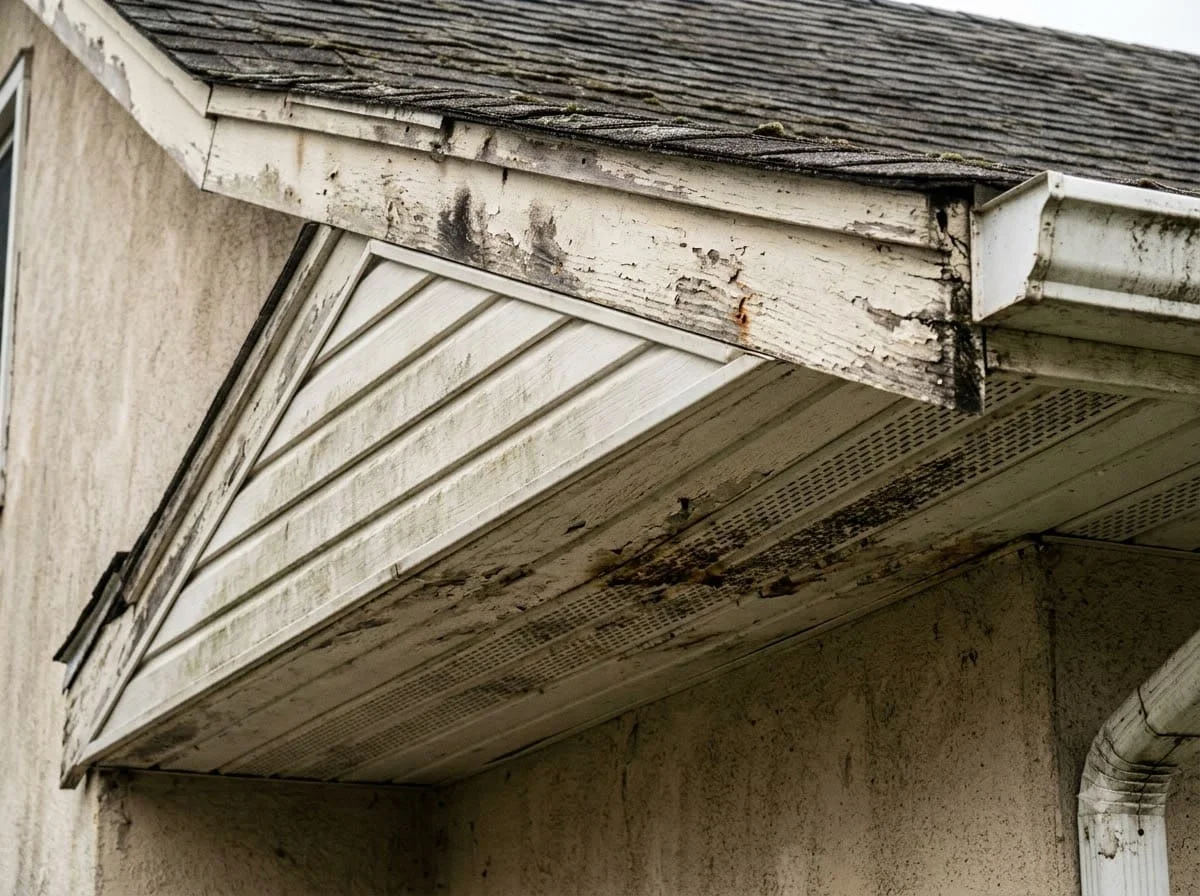
Aluminum soffit lasts 40 to 50 years, vinyl soffit lasts 20 to 40 years, and painted wood soffit lasts 10 to 30 years depending entirely on how often it is repainted. Those three ranges cover the vast majority of American homes, and they are wide for a reason — the material sets the ceiling, but attic ventilation, climate, and installation quality decide where inside that range your soffit actually lands.
There is a second answer hiding behind the first. The panel you can see is rarely the part that fails. Behind every soffit run sits a sub-fascia board and a row of rafter tails, and that wood is what a replacement job is usually chasing. Soffit Fascia Repair's contractors regularly pull down 25-year-old vinyl panels in perfect condition to find framing that rotted out a decade earlier. Understanding both timelines — the panel's and the framing's — is what tells you whether you are looking at a repair, a replacement, or another ten good years.
Soffit Lifespan by Material — Quick Reference
Soffit lifespan by material breaks down into five common options, each with a distinct failure mode rather than a simple expiry date. The table below gives the realistic service range for each, followed by what actually goes wrong at the end of it.
| Material | Expected Life | How It Fails |
|---|---|---|
| Aluminum | 40–50 years | Dents, chalking finish, corrosion at scratches |
| Vinyl | 20–40 years | UV embrittlement, fade, heat warping, cracking |
| Wood (painted) | 10–30 years | Paint failure, then rot from the seams inward |
| Fiber cement | 30–50 years | Edge swelling if unsealed, fastener rust-through |
| PVC / cellular | 30–50 years | Thermal movement at seams, surface chalking |
Aluminum Soffit: 40 to 50 Years
Aluminum soffit lasts 40 to 50 years because the material itself does not degrade in any way that matters at eave height. It does not absorb water, it does not feed fungus, and it does not become brittle in cold or soft in heat. Aluminum panels installed in the 1970s are still doing their job on plenty of homes today, generally with nothing wrong beyond a faded, chalky finish.
What ends aluminum's life is physical damage rather than decay. Hail dents it. A ladder set carelessly against the eave creases it. Wind-driven debris punches through the thinner gauges. And once the baked-enamel finish is scratched through in a coastal environment, salt reaches the bare metal and corrosion starts at that point and spreads.
The practical takeaway: aluminum rarely needs replacing on account of age alone. When aluminum soffit comes down, it is usually because the homeowner wants a color change, because a roof or fascia job requires removing it, or because the wood behind it has failed. If you have aluminum soffit and it looks tired but intact, refinishing is often the better answer than replacing.
Vinyl Soffit: 20 to 40 Years
Vinyl soffit lasts 20 to 40 years, and where a specific home falls in that 20-year spread is almost entirely a question of sun exposure. Ultraviolet radiation breaks down the polymer over time, which shows up first as color fade and eventually as embrittlement — the point at which a panel that used to flex now cracks when it is pressed.
Heat compounds the problem. Vinyl expands and contracts significantly with temperature, and a south- or west-facing eave in a hot climate cycles through that movement every single day. Panels installed too tightly, without room to float in their channels, buckle and wave under that stress long before the material itself would have failed.
This is why the same product carries very different expectations in different regions. A vinyl soffit on a shaded north elevation in Michigan can comfortably reach 40 years. The identical panel on a west-facing eave in central Florida or Arizona may be brittle and fading by year 20. Our full aluminum vs vinyl soffit comparison breaks down which one makes sense for which climate.
Wood Soffit: 10 to 30 Years — And You Control It
Wood soffit lasts 10 to 30 years, and it is the only material on this list whose lifespan is genuinely in the homeowner's hands. The wood is not what protects the wood. The paint film is. As long as that film is intact, the panel stays dry and can last for decades — plenty of century-old homes still carry original wood soffit that has simply been repainted every seven to ten years.
Once the paint fails, the clock speeds up dramatically. Micro-cracks in an aging paint film let moisture into the end grain at panel seams and edges, and wood-rot fungi need only sustained moisture above roughly 19% content to establish. From there, decay moves inward from the seams, and a soffit that looked fine three years ago starts to feel spongy.
The failure sequence is worth knowing because it is reversible early and not reversible late. Chalky, dull paint is a maintenance signal. Cracking and peeling paint is a repaint deadline. Soft wood under thumb pressure means rot has already established and the panel needs to be cut out. See what causes soffit rot for how to identify the moisture source driving it.
The Lifespan Nobody Quotes: The Wood Behind the Panel
The wood behind the panel has its own lifespan, and it is the one that usually triggers replacement. Sub-fascia, rafter tails, and the framing your soffit is fastened to are structural lumber, and structural lumber rots when it stays wet — no matter what the panel covering it is made of.
This creates a situation that surprises a lot of homeowners. Vinyl and aluminum are non-porous, which means they do not rot, but it also means they trap humid attic air against the wood behind them and hide the resulting damage from view. A soffit run can look flawless from the driveway while the sub-fascia above it has gone soft enough to fail a fastener pull test.
The tell is mechanical rather than visual. Panels that bow, sag between supports, or pull loose from their channel are reporting that the wood they are nailed into no longer holds a fastener. That is a framing problem wearing a panel's clothing, and no amount of panel replacement fixes it.
Five Factors That Decide Where You Land in the Range
Five factors decide where your soffit lands inside its published range, and they are listed here in order of how much they actually matter.
First, attic ventilation. This outranks everything else. Soffit vents are the intake side of a system that pulls cool air in at the eave and exhausts warm, moist air at the ridge. When that airflow is blocked — by insulation stuffed into the eave, by paint sealing the vent perforations, or by pest nesting — humidity stays trapped in the eave cavity and condenses on the wood. Homes with balanced ventilation routinely reach the top of the range. Homes without it routinely fail decades early.
Second, climate load. UV intensity shortens vinyl. Salt air attacks aluminum wherever the finish is compromised. Freeze-thaw cycling works fasteners loose and drives ice dams that push water back under the eave. Hail dents metal and cracks aged vinyl. Every region has its own dominant stressor, and it sets a lower ceiling than the manufacturer's number.
Third, installation quality. Soffit panels are designed to float. Fastened too tightly, they cannot expand and contract, so they buckle. Fastened too loosely or into rotted wood, they work free in wind. J-channel that was not properly lapped lets wind-driven rain into the eave from day one. A good installation adds years; a rushed one can cost a decade.
Fourth, gutter performance. Overflowing gutters send water into the soffit-fascia junction on every heavy rain, and that joint is the most common entry point for eave rot. The relationship runs both directions, which we cover in why gutters cause fascia rot.
Finally, pest pressure. Squirrels, birds, bats, and rodents all enlarge small gaps into permanent openings, and once the eave cavity is open to weather and nesting material, moisture follows. Regions with heavy tree canopy and established squirrel populations see this far more often than open suburban lots.
How to Tell Where Your Soffit Is in Its Life
Telling where your soffit is in its life takes about ten minutes from the ground with binoculars and a walk around the house. Work through these signals in order.
- Color and surface. Even fade across a whole elevation is normal aging. Blotchy discoloration or dark streaking in one area points to a localized moisture source.
- Panel geometry. Straight, flat panel lines mean the framing is sound. Waves, bows, or sag between supports mean movement behind the panel.
- Seams and channels. Gaps opening at J-channel, panels sliding out of their track, or visible daylight into the eave all indicate fastener or framing failure.
- The vents. Painted-over, crushed, or blocked vent perforations mean the eave has not been breathing — which changes the whole prognosis, regardless of how the panels look.
- The fascia line. Fascia and soffit fail together far more often than separately. Peeling paint, dark staining, or a gutter pulling away from the fascia are all early warnings for the soffit behind it.
If three or more of these show up along the same run, the soffit is near the end of its serviceable life whatever its age on paper. If only one appears in one spot, you are almost certainly looking at a localized repair.
Repair or Replace at End of Life
Repair or replace at end of life comes down to two questions: how much of the run is affected, and is the framing behind it sound. Isolated damage over solid wood is a straightforward soffit repair. Damage recurring at several points along the same elevation, brittle panels across a whole face, or soft sub-fascia all point toward full soffit replacement.
There is a cost crossover that makes the decision easier. Once more than roughly a third of a run needs work, replacing the entire run generally costs less than repeated patching — and it solves the color-match problem that partial repairs on faded panels always create. Our soffit replacement cost guide covers current per-linear-foot pricing, and repair vs replacement walks through the decision in more detail.
One piece of timing advice worth acting on. If your roof is due within a few years and your soffit is in the last quarter of its life, do them together. The eave is already open, access and staging are already paid for, and the drip edge, fascia, and soffit-fascia junction can be detailed as one continuous system instead of three separate visits.
Not sure where yours stands? Call Soffit Fascia Repair at (855) 606-2187 for a free inspection. A contractor will check the panels, probe the sub-fascia and rafter tails behind them, confirm whether your soffit vents are actually breathing, and tell you honestly whether you are looking at a repair, a replacement, or another decade of service.
Frequently Asked Questions
How long does soffit last?
It depends almost entirely on material. Aluminum soffit lasts 40 to 50 years and often outlives the roof above it. Vinyl lasts 20 to 40 years, with the lower end typical in high-UV, high-heat climates. Painted wood lasts 10 to 30 years and is the only material whose lifespan is set by maintenance rather than by the material. Fiber cement and PVC both run 30 to 50 years. In every case the panel usually outlasts the wood framing behind it, so replacement is often triggered by rotted sub-fascia rather than by panel failure.
How long does aluminum soffit last compared to vinyl?
Aluminum typically lasts 10 to 15 years longer. It does not become brittle in cold or soften in heat, so it holds its shape through the thermal cycling that eventually warps vinyl. Vinyl's weak points are UV embrittlement, color fade, and heat distortion, all of which accelerate in southern climates. Aluminum's weak points are denting from hail and corrosion at scratches in salt air. In a hot, sunny region aluminum's advantage is largest; in a mild northern climate the gap narrows considerably.
What makes soffit wear out faster?
Poor attic ventilation is the biggest factor, because trapped humid air condenses inside the eave and rots the wood the panels are fastened to regardless of panel material. After that comes climate load — UV, salt air, freeze-thaw cycling, and hail. Installation quality matters nearly as much, since panels nailed tight instead of allowed to float will buckle within a few seasons. Overflowing gutters and pest entry round out the list. Fix ventilation and drainage and most soffit reaches the top of its range.
How do I know if my soffit needs replacing or just repairing?
The deciding factors are how much of the run is affected and whether the wood behind the panels is sound. Damage confined to one or two sections with solid framing behind them is a repair. Damage at multiple points along the same run, panels chalky and brittle across a whole elevation, or soft sub-fascia and rafter tails point to replacement. As a rule, once more than about a third of a run needs work, replacing the full run costs less than repeated patching and gives a consistent color match.
Does soffit need to be replaced when the roof is replaced?
Not automatically, but it is the cheapest time to do it. Aluminum soffit at 40 years old will likely outlast a new roof, so replacing it alongside the roof is optional. Wood soffit near the end of its life, or any soffit with rot in the sub-fascia, should be handled during the roof job — the eave is already exposed, access and staging are already paid for, and the drip edge and soffit-fascia junction can be detailed as one system. Deferring it means paying for eave access twice.