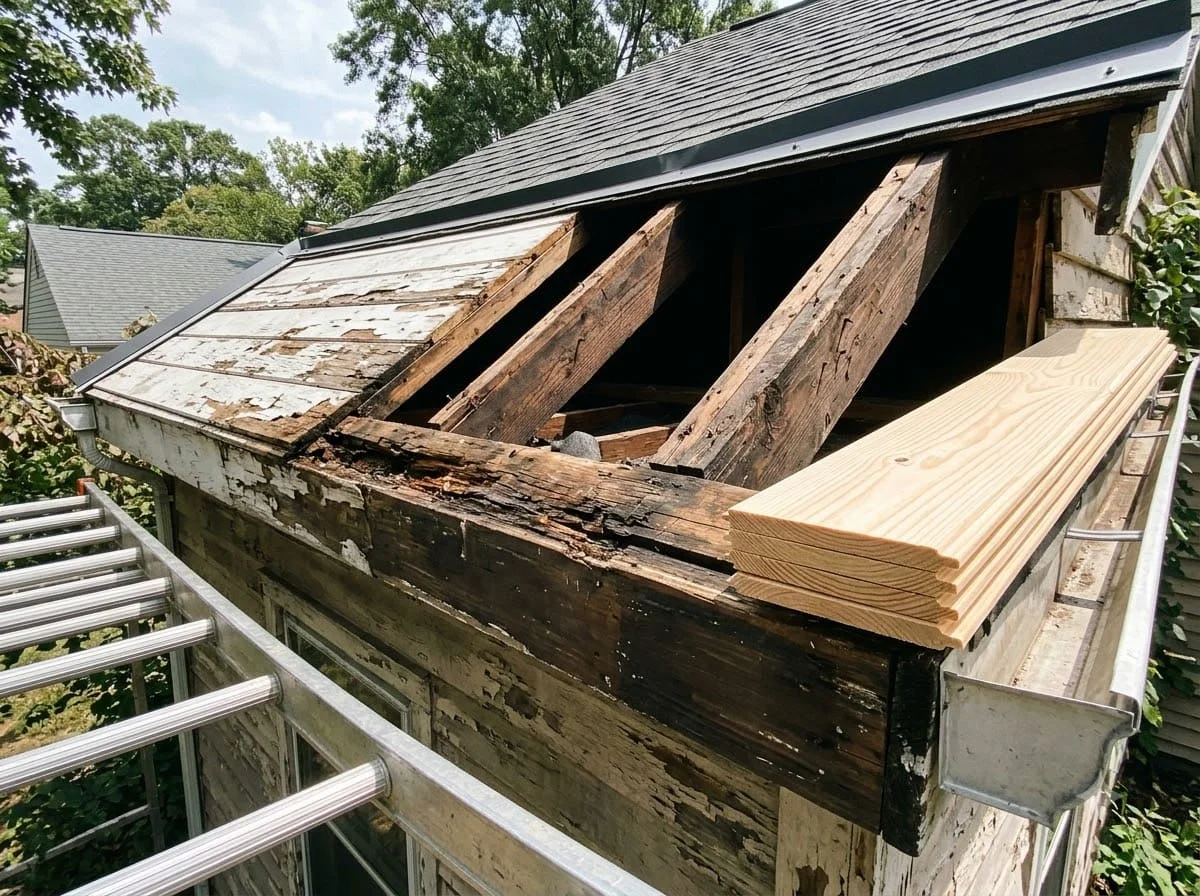
Wood soffit replacement runs $8 to $20 per linear foot installed, which puts a typical 150 to 200 foot single-story home somewhere between $1,500 and $3,500. But the number that matters more is 30 — the number of years the material you choose now has to survive before anyone touches the eave again.
Wood soffit fails on a schedule set by its paint film, not by the wood. Keep the paint intact and wood soffit can last decades. Let the paint crack and moisture reaches the end grain at the seams, where wood-rot fungi need only sustained moisture above roughly 19% content to establish. That is why homeowners replacing wood soffit face a question that homeowners replacing aluminum never do: put the maintenance cycle back, or engineer it out. Soffit Fascia Repair's contractors handle both, and the right answer depends on your climate, your house, and how you feel about ladders.
When Wood Soffit Needs Replacing Rather Than Repainting
Wood soffit needs replacing rather than repainting once decay has passed the surface and reached the body of the board. The distinction is not visual, it is mechanical, and a screwdriver settles it in about five seconds per test point.
- Firm resistance under a soft skin. Surface deterioration only. Strip, consolidate, prime, repaint. The board stays.
- The probe sinks with light pressure. Rot has penetrated the board. That section comes out.
- The probe reaches framing that is also soft. The sub-fascia or rafter tails are involved. Now it is structural work, not panel work.
Other replacement triggers do not require a probe at all. Panels sagging between supports mean fasteners are no longer holding. Visible daylight into the eave means the envelope is open to weather and pests. Multiple failure points along one run mean the whole run has reached the same age at the same time, and patching it section by section just spreads the work across several visits at a higher total cost.
The Three Real Options
Three real options exist once wood soffit has failed, and they differ far more in the long run than in the quote.
| Option | Typical Cost / LF | Next Maintenance |
|---|---|---|
| Repair & repaint existing wood | $4–$9 | Repaint in 7–10 years |
| Replace with new wood | $8–$14 | Repaint in 7–10 years, ongoing |
| Convert to vented aluminum | $10–$20 | None for 40+ years |
Aluminum conversion typically costs 20% to 40% more than replacing in kind. Across a 40-year horizon it is not close — the wood option absorbs four or five repaint cycles that the aluminum option does not, and each of those cycles carries its own ladder work, prep, and materials.
Why Aluminum Wins in Most Climates
Aluminum wins in most climates for one structural reason: it removes the food source. Wood rot is fungal decay, and fungi need cellulose to digest. Aluminum offers none, so the failure mode that ends wood soffit simply does not apply.
The advantages compound from there. Aluminum panels come factory-finished in baked enamel that holds color for decades without a brush ever touching them. They do not absorb water, so they do not swell, cup, or telegraph seams. Vented aluminum panels also deliver consistent, engineered net free vent area, which matters because hand-cut vent openings in old wood soffit are frequently undersized and often painted half-shut.
Climate sharpens the case. In humid Southeast and Gulf Coast markets, paint films fail faster and rot establishes quicker, so wood's real-world life sits at the bottom of its range. In coastal salt air, aluminum needs its finish kept intact but still dramatically outlasts painted wood. In northern freeze-thaw regions, wood absorbs moisture, freezes, and delaminates at the seams — a cycle aluminum is immune to. Our aluminum vs vinyl soffit guide covers the third option if you are also weighing vinyl.
When Keeping Wood Is the Right Call
Keeping wood is the right call in three specific situations, and in these cases converting to aluminum is the wrong move regardless of maintenance math.
Historic districts and architectural review. Homes in designated historic districts frequently carry material requirements that rule out aluminum on visible elevations. Beadboard and tongue-and-groove eaves on Craftsman, Victorian, and Colonial Revival homes are original architectural detail, and replacing them with flat aluminum panels visibly changes the building. In these cases the right answer is like-for-like wood replacement with a rigorous paint schedule.
Sound wood with a failed finish. If the boards probe firm and only the paint has gone, replacement is premature. Strip, spot-consolidate, prime with a quality exterior primer, and topcoat. That resets the clock for another seven to ten years at a fraction of replacement cost.
Partial damage on a distinctive profile. Where only one section has failed on an eave with a profile that cannot be matched off the shelf, splicing in milled wood preserves the run. Mixing aluminum into part of a wood eave looks exactly as patched as it is.
How the Replacement Actually Goes
The replacement itself follows a fixed sequence, and understanding it tells you what a legitimate quote should include.
First, the eave is opened. Old panels come down along the full run rather than only at the visible damage, because the extent of rot is almost never what it looks like from the ground. Gutters are usually detached or supported at this stage.
Second, the framing is inspected and repaired. Sub-fascia and rafter tails are probed for soft wood, and anything that fails is cut back to sound material and sistered or replaced. This is the step that separates a real job from a cosmetic one, and it is where honest quotes carry an allowance rather than a flat price.
Third, the moisture source is corrected. Blocked vents are cleared, insulation baffles are installed to keep the eave breathing, and gutter or drip-edge problems are addressed. Skipping this guarantees the new soffit follows the old one. Our guide to soffit vents and attic ventilation explains why intake airflow governs the whole eave.
Fourth, the new soffit goes in. J-channel or F-channel is set at the wall and fascia, and panels are installed with room to move — snug but not pinned, because every material on the list expands and contracts with temperature. Vented and solid panels are alternated to hit the required net free vent area.
Finally, the fascia and gutters are re-detailed. Fascia is wrapped or replaced as needed, drip edge is lapped correctly over the fascia, and gutters are rehung on sound wood. A run of 150 to 200 feet is typically one to two days once access is set.
What Homeowners Get Wrong
Two mistakes account for most of the repeat work we see on wood soffit jobs.
The first is capping over old wood. Installing aluminum or vinyl directly over deteriorating wood soffit is offered as a cost saver, and it does save money on the day. It also seals existing decay inside the eave, blocks the original vent openings unless they are deliberately cut through, and fastens new panels into wood that may already be too soft to hold them. Worst of all it hides the problem, so the next time anyone looks the damage is structural.
The second is replacing soffit while ignoring fascia. The two meet at a joint that shares identical moisture exposure, so they age together. Fitting a crisp new soffit panel against a warped, rotting fascia board leaves an imperfect seal at precisely the junction where water enters. If the fascia shows staining, soft spots, or a gutter pulling away from it, handle both — see why gutters cause fascia rot and our fascia replacement service page.
Ready to price it out? Call Soffit Fascia Repair at (855) 606-2187 for a free inspection. A contractor will probe the wood, check the framing behind it, and quote both the like-for-like wood replacement and the aluminum conversion so you can compare them directly. Current pricing for both paths is in our soffit replacement cost guide.
Frequently Asked Questions
Should I replace wood soffit with aluminum?
For most homeowners tired of the repaint cycle, yes — and especially in humid, coastal, or high-UV climates where paint fails fastest. Aluminum does not rot, never needs repainting, and lasts 40 to 50 years against wood's 10 to 30. The cases for keeping wood are historic homes under district review, homes with decorative beadboard or tongue-and-groove eaves where the detail is architecturally important, and homes where the existing wood is still sound and the owner genuinely does not mind repainting every seven to ten years.
How much does wood soffit replacement cost?
Typically $8 to $20 per linear foot installed, with new wood at the lower end and aluminum conversion in the middle of that range. A single-story home with 150 to 200 linear feet of eave usually lands between $1,500 and $3,500. Two-story homes, steep pitches, and deep overhangs push it higher because of staging and access. Rotted sub-fascia or rafter tails found during tear-off add $6 to $15 per linear foot, and that repair is not optional once discovered.
Can you replace wood soffit without replacing the fascia?
Yes, but it is often false economy. Soffit and fascia meet at a joint with identical moisture exposure, so when one has rotted the other is usually well along the same path. Replacing soffit alone also means fitting a new panel to an old fascia board that may not be straight, which compromises the seal at exactly the junction where water gets in. If the fascia is sound and dry, soffit-only is reasonable. If it shows staining, soft spots, or a gutter pulling away, do both.
Can rotted wood soffit be repaired instead of replaced?
Early surface rot with a sound core can be repaired — strip the failed paint to bare wood, treat with a wood consolidant and epoxy filler, then prime and repaint. This works when a probe meets firm resistance under the soft surface layer. Once a screwdriver pushes through with light pressure, or the rot has reached the framing behind the panel, the section has to be cut out and replaced. Either way the moisture source still has to be corrected.
Does aluminum soffit go over existing wood soffit?
It can be done, and some contractors offer it as a cheaper option, but it is rarely a good idea. Capping over wood traps existing moisture and decay, hides future rot from view entirely, and fastens new panels into wood that may already be failing. It also blocks the original vent openings unless they are carefully cut through. A proper conversion removes the old wood, inspects and repairs the sub-fascia and rafter tails, then installs vented aluminum on sound framing.